
Targeted feeding, improved forage, and slatted housing have reduced disease pressure, accelerated lamb finishing and boosted flock capacity by over 35% on a 370-acre upland unit.
Housing ewes for up to four months pre-lambing would prove a costly exercise for many, but it is undoubtedly paying dividends for Lanarkshire pedigree and commercial sheep farmer, Andrew Campbell.
Having taken over the 370-acre upland grassland unit at Overburns, Lamington, a few years ago, Andrew has been able to increase flock numbers from 900 to 1250 breeding ewes purely by housing his pre-lambing ewes in a new 800m x 80m slatted sheep shed.
Further investment reseeding old pastures with high sugar grasses and concentrating on producing two cuts of quality, leafy silage rather than one bulky crop, and feed costs have been slashed.
“We can run far more ewes purely because the sheep are housed from early January through until
two or three days after they’ve lambed, which in turn saves the grass and ensures a good fresh bite for when the ewes need it most,” said Andrew.
“Ewes now go out onto fresh grass fields in a fitter and healthier state with their lambs which are also better nourished because the ewes have been better fed on the run up to lambing,” he added.
As a result, lambs are finishing two or three weeks earlier on average because they are hitting the ground running, having received the best quality colostrum from ewes that have been fed for maximum milk production that continues out at grass.
Key to such high-quality nutrition is a tailored diet devised by Harbro beef and sheep nutritionist
Jill Hunter. Over the past couple of years, Jill has advised what feeds to supplement the high-quality chopped big bale silage, which is mixed in a Silo King and fed as a total mixed ration (TMR).
With numerous large pens in the new slatted shed, ewes can be fed according to their condition scores/weights and individual needs too. Ewes
are weighed and condition scored every three weeks before scanning, to ensure the correct plane of nutrition. After scanning, ewes are split between twin-bearing, single and triplets and fed accordingly.
Ewes scanned for twins are fed a Premium Ewe 18% as a meal to prevent sorting, which is built up to 0.7kg per head per day four weeks before lambing. Triplet-bearing ewes are fed the same ration, but six weeks before and those expecting single lambs are introduced to the feed at a 0.1kg per head two weeks before.
Feeding such a large number of sheep in the one shed by a machine has, as a result, become more
efficient, when they only need to be fed every two days although the ration is pushed up every day.
With the feed always available, the sheep are a lot more content and settled compared to being fed once a day if they had been outside.
“There’s not the same rush for feeding that you would see when you feed ewes outside with a snacker and there’s not the same bullying or wastage of feed,” Andrew said.
However, he added that while the ewes have to be packed in fairly tightly to keep them clean, shepherd Raymond Baynes and his daughter, Anna have found there are still the odd shy eaters that have to be pulled out and given a pen with more space.
But, with the ewes fed a constant feed which is always available, there are not the same health issues.
“We used to feed round bales of silage in the shed but we found there would be a lot of wastage and the odd abortion because the ewes were getting stressed out trying to get to the feed.
“Since we started feeding a TMR and tailoring the ration according to the quality of the silage we have, we’ve seen far less twin-lamb disease and prolapses. We’re getting fewer cases of mastitis than we used to as well, because the ewes are healthier. And, because they’re on slats, there is not the lameness,” said Andrew.
“There is a consistent level of hygiene on slats which is far better than moist, soft or wet straw. Our ewes lamb on the slats and are then put into individual pens with their lambs until they are up and suckled.”
Ewes and lambs are then shipped out to grass where they are fed Premium Ewe 18 rolls via a snacker, while the pedigree lambs have access to a Kelso Baby Lamb pellet to prevent sorting.
“Feeding a pellet is far cheaper than feeding a coarse mix. Coarse mixes might look more appetising, but the lambs don’t know any difference and there is the same nutrition in a pellet as in a mix. There’s also far less wastage with a pellet.”
Andrew also relies on Maxammon Kelso Tup & Lamb nut, mixed grain and beet pulp mash to feed his pedigree tups for the sales.
“We’ve used the mash for the past couple of years now and it really puts that extra cover and shine on the sheep without putting them over the top,” said Andrew.
Relying on various Harbro feeds and buckets and the unique skills of a nutritionist might appear a costly option compared to a more traditional system based on a quad bike and a snacker six weeks pre and post lambing, but the change has been revolutionary at Overburns.
“The difference in the health and productivity of our ewes has been amazing,” said Andrew. “The reduction in feed costs per ewe must be colossal. Not only have we improved levels of efficiency but our carbon footprint has been reduced, so we’re ticking all the boxes.
“We’re producing more, healthier lambs that are finishing earlier so our margins are improving which
Relying on various Harbro feeds and buckets and the unique skills of a nutritionist might appear a costly option compared to a more traditional system based on a quad bike and a snacker six weeks
pre and post lambing, but the change has been revolutionary at Overburns.
“The difference in the health and productivity of our ewes has been amazing,” said Andrew. “The reduction in feed costs per ewe must be colossal. Not only have we improved levels of efficiency but our carbon footprint has been reduced, so we’re ticking all the boxes.
“We’re producing more, healthier lambs that are finishing earlier so our margins are improving which is helping to pay for the shed which was a massive investment. By having a slatted shed which can house 1000 ewes we’ve been able to reduce our straw costs and by housing them from early January onwards we’ve been able to increase flock numbers.”
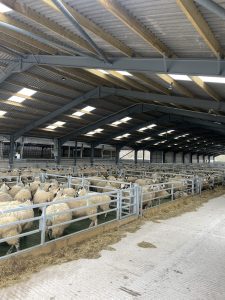
Image kindly provided by Thornburn Group Ltd www.thornburn group.co.uk