Everyone’s Talking About Milk Prices
Caitlin Palmer, Harbro Dairy Nutritionist

Caitlin Palmer, Harbro Dairy Nutritionist
Milk price is the main topic of conversation on farms at the moment. Everyone is affected by it and with the expectation that the prices are to fall further before they recover, a lot of what our dairy team are currently doing is reviewing costs and developing bespoke strategies to support customers.
A wise person once said to me ‘your stock shouldn’t know the milk price is coming down’. That mindset is very important. With milk prices expected to rise again later in 2026 we still want the youngstock and milking cows to be healthy and performing as well as they can – maintaining performance now protects future income.
The fundamentals of herd performance and targets shouldn’t change:
With this in mind, what changes can be made and where can costs be reduced?
Firstly, it’s key to know what your costs are to enable you to decide where costs can be reduced and what the impacts will be. Instead of looking at price per tonne, looking at measurements such as cost/kg liveweight gain for youngstock or margin over purchased feed for milking cows is better as you can take into account the performance of the stock. For example, you could change your calf milk powder to a cheaper option with a price reduction of £200/T, but if it results in even a 0.1kg/day growth reduction, the cost/kg gain will be higher, and the change was actually counter-productive. Harbro have tools to enable us to look at the costs and run through different scenarios to find the best option for your farm.
Efficiency should be a focus for all farms, but when milk price drops, this becomes one of the most powerful tools a farm has. In milking cows, feed efficiency, which is the kg energy-corrected milk produced per kg dry matter intake, is an easy and meaningful parameter to measure and track. The goal is to turn every kg of dry matter intake into as many litres as possible. To achieve this, the ration must be correctly balanced, rumen function has to be optimised and health and management need to be prioritised. Month after month, our Milk Monitor shows that the most efficient cows are generating the strongest margin.
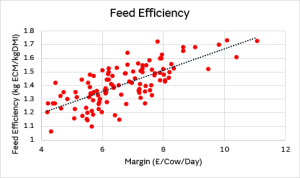
Increasing milk from forage is an option – based on our in-house analysis, 2025 Scottish silages were the best we’ve had in the last 5 years in terms of available energy and protein. Reviewing your milk from forage with your Harbro specialist then looking at increasing the forage levels while keeping the ration balanced can help reduce cost.
For those on TMRs, look at your low yielding groups, or for those on one-group TMRs, create a lows group with more forage and less concentrates. Focus on reducing costs with the lows and continue to look after your highs groups so they are hitting peak and getting into calf.
Can some cows be dried off earlier? This needs careful consideration as you don’t want to go too far and end up with fat cows. A two-stage dry cow period could help here and would mean a cheaper ration could be fed in the far-off period. Lying, feed and water space is also very important, and therefore drying more cows off might not be possible if space is tight. If we get a dry start to the summer, consider putting far-off dry cows out to grass.
Every farm is different – different contracts, different systems and different situations. This is why there isn’t a one size fits all answer but there are many options. Your Harbro Dairy Specialist can help you review your system, run costed scenarios and build a strategy that protects performance while managing spend.
On a slightly different note, when I entered this industry, the milk prices were at the lowest they’d been, with many in the low teens. It was a tough time, but farmers are resilient and we got through it. With that being said, it’s important to reach out to someone if you’re struggling. The RSABI offer practical, emotional and financial support to Scottish farmers. Contact them on 0808 1234 555 or visit www.rsabi.org.uk.
Milk price cycles are something farmers have weathered many times before, but the decisions made now will shape how strongly herds bounce back when prices recover.