Where and When will Worms and Liver Fluke hit?

This year, up until the end of August, has been one of the hottest and driest on record for the UK. The national picture does, however, hide some local and regional variations that will make a significant difference when it comes to predicting how gut worms and liver fluke will behave. When it comes to controlling these parasites, the aim for treatments is always to use the right product at the right time in the right animals, and to get this right, knowing what the parasites are likely to be doing is key.
Gut worms and liver fluke, because they have very different lifecycles, follow different timescales in responding to changes in the weather. For gut worms we need to be thinking about what the weather has been doing over the last two or three weeks, whereas for liver fluke we need to look back as far as May/June and consider what the weather has been for the whole summer, with the fluke infection risk taking around 8 weeks to respond to changes in the weather.
This year, where it has been hot and dry, most worm eggs will have remained dormant within dung balls on pasture, meaning lambs will have seen very few worms. Good for lamb growth rates so far, but when the rain does come after a long dry spell, all these eggs will hatch at about the same time.
Any fields that have held lambs since the spring could then give lambs a huge larval worm challenge two or three weeks after it rains. Under normal circumstances monitoring worm egg counts from lambs is a great way to pick up a rising worm burden before growth rates suffer too much, but when there is a sudden increase in worm larvae on the pasture the bulk of the worm burden in the lambs can be immature worms.
The worm egg count can then take two to three weeks to catch up with the worm burden.
Avoiding this challenge, i.e. putting lambs somewhere that hasn’t held lambs already, will always give the best results for the lambs. Where this can’t be done, egg count results are still useful, but have to be taken together with the condition of the lambs, and the knowledge that egg counts might be lagging behind worm burdens.
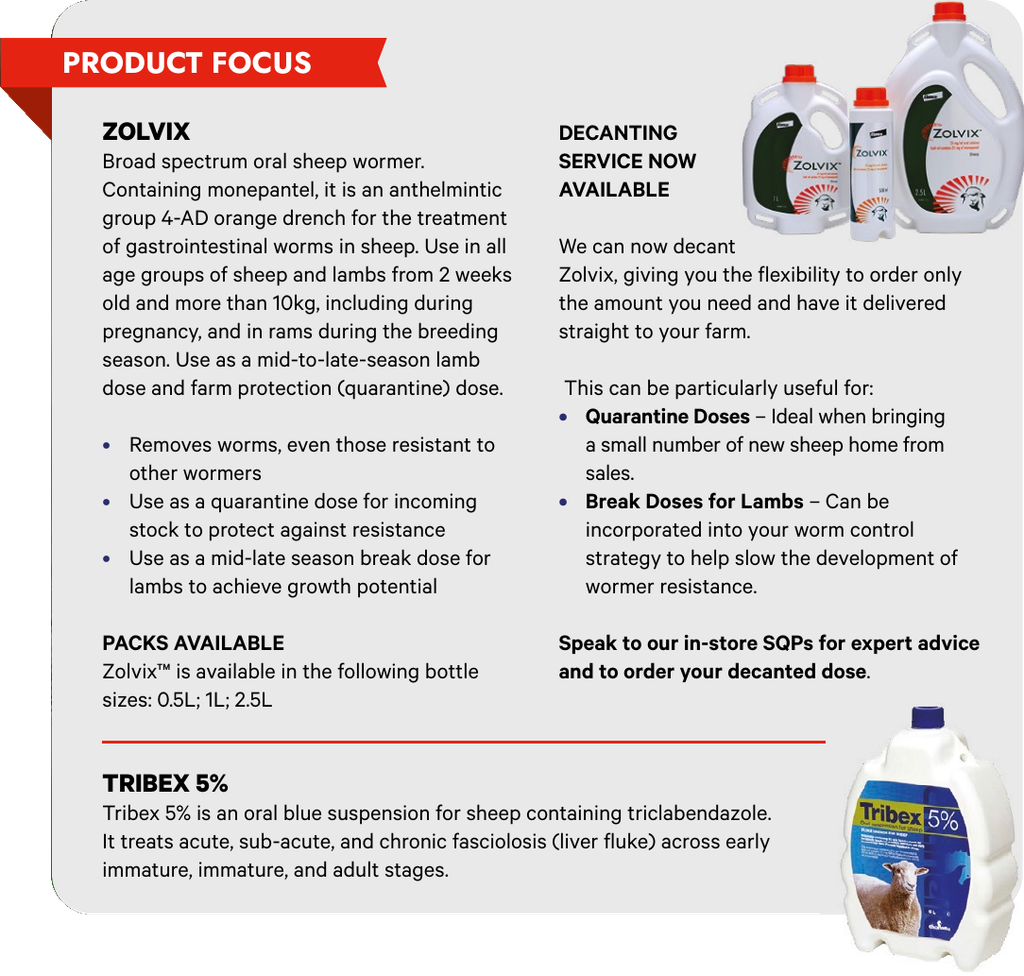
Whatever the management challenges, when a treatment is needed, it is important to make sure that treatment has been effective, and in the autumn, this is the right time to be using one of the newer group four or five wormers, for example Zolvix™ for the “break dose” in lambs.
For liver fluke, after a mainly dry summer, we’re likely to see another low challenge fluke season, with that challenge coming later in the year on most farms.
Knowing when the fluke challenge starts on your farm is key to using the right product at the right time in the right animals.
A recent on farm post-mortem of a thin ewe showed a small number of adult fluke left behind from last year. This flock had been given the right products in the right order at the usual handling times, but with it being a late fluke season last year, these treatments were all just a bit too early, leaving some fluke behind.
We are all learning to adapt to the unpredictable weather so speak with your local Harbro SQP to find out how we can help ensure you make the most of your medicines.
REMEMBER: our team of SQPs can also advise on worming and fluke prevention products for cows and calves – ask in-store or speak to your on-farm specialist.